
Manufacturing Facility Roofing
Manufacturing Facility Roofing gets scoped from roof evidence, operating risk, Amarillo weather exposure, and the decision the building owner needs to make.
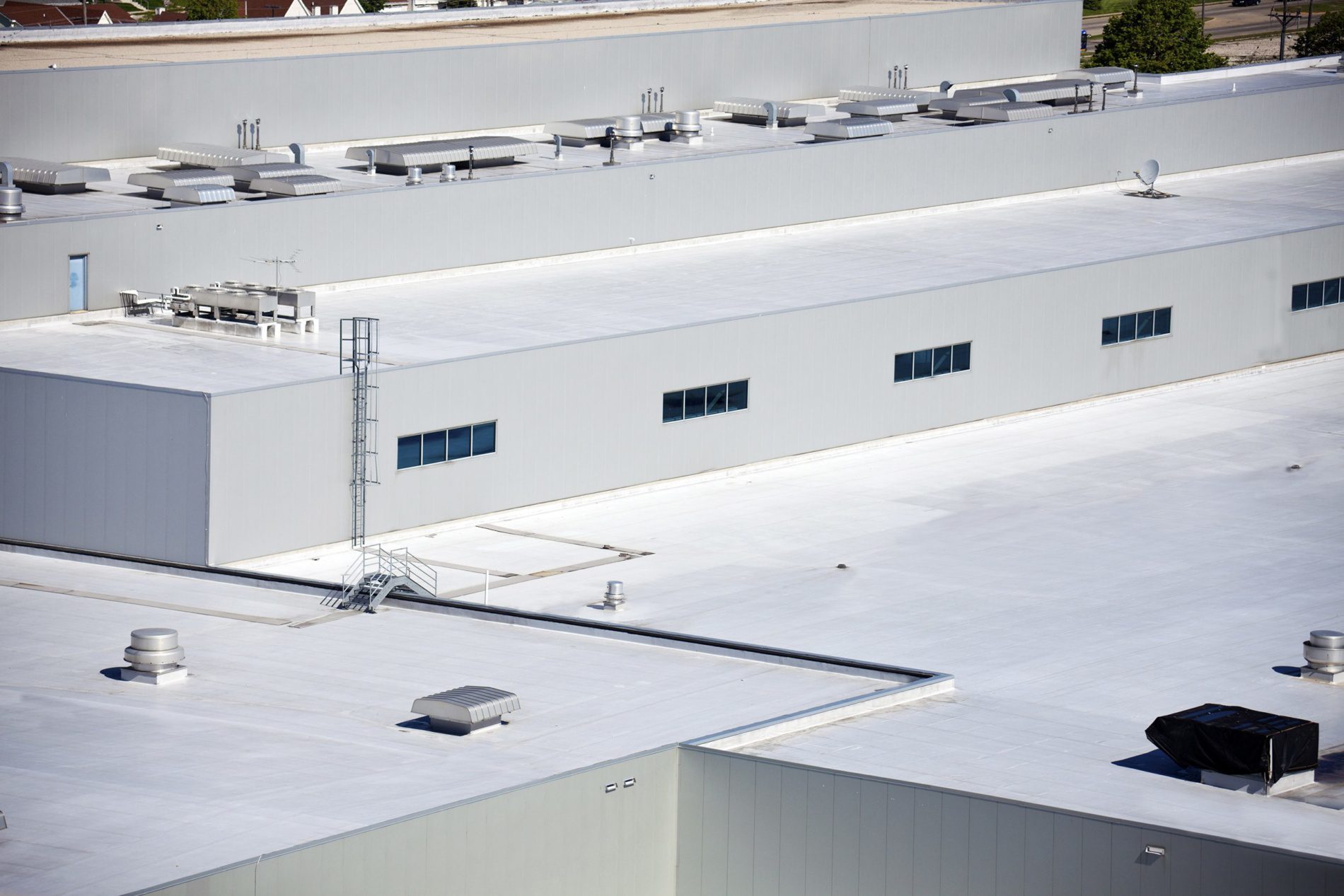
Manufacturing Facility Roofing in Amarillo, TX
Amarillo sits at the intersection of the Texas Panhandle's beef processing, petrochemical, and helium production industries, and Tyson Foods' large beef processing complex on the east side of the city represents the kind of demanding manufacturing environment where commercial roofing failures carry immediate operational and food safety consequences. Manufacturing facilities across the Amarillo area face roofing conditions shaped by West Texas wind loads, extreme thermal cycling, and process environments that degrade standard membranes far faster than textbook service life projections suggest.
Process equipment on Amarillo manufacturing roofs includes cooling towers, industrial exhaust and ventilation systems, and specialized processing equipment that must remain operational regardless of roofing work schedules. In food processing facilities, refrigeration condensers and cooling systems cannot be shut down — the cold chain cannot break. In petrochemical operations, exhaust and gas management systems are safety-critical. We survey all roof-mounted equipment before mobilizing, map their operational requirements, and design work sequences that allow reroofing to proceed without interrupting equipment operation. Emergency shutdown protocols are documented and shared with plant operations teams before work begins.
Chemical and fume exposure at Amarillo manufacturing facilities takes forms specific to the Panhandle's industrial mix. Beef processing generates organic vapors and cleaning chemical mists at the roofline that degrade standard membranes through biological activity and chemical attack simultaneously. Petrochemical processing introduces hydrocarbon vapors. Fertilizer and agricultural chemical manufacturing, significant in the Amarillo area, produces corrosive airborne compounds. We specify membrane systems with demonstrated resistance to the specific chemical environment at each facility — generic specifications derived from office building experience consistently underperform in Amarillo's industrial environments.
West Texas wind loads are among the most severe in the continental United States, and Amarillo's position on the exposed Panhandle plateau makes wind uplift a primary design driver for every manufacturing roof in the area. Standard fastener patterns designed for less exposed locations are inadequate here. We specify uplift resistance based on ASCE 7 calculations for Amarillo's wind zone, increasing fastener density at perimeters and corners to levels that often surprise facility managers accustomed to seeing national standard specifications. The additional fastener cost is trivial compared to the cost of a partially delaminated membrane on a food processing or chemical facility.
Thermal cycling in the Texas Panhandle is extreme in both directions. Amarillo's elevation and continental climate produce summer roof surface temperatures exceeding 160 degrees Fahrenheit and winter lows that can drop well below freezing within hours of a blue norther front passage. These rapid, large-amplitude thermal swings stress membrane seams and penetration flashings at rates that reduce expected service life significantly compared to more moderate climates. We account for Texas Panhandle thermal range when selecting seam overlap widths, specifying weld temperatures, and designing expansion joints into large roof planes.
Vibration from heavy processing equipment — stamping lines, conveyor systems, and large rotating machinery — transmits into the roof deck at Amarillo manufacturing facilities and accelerates fatigue at seams and rigid penetrations. We conduct deck surveys before reroofing to identify sections where vibration has already caused fastener loosening or deck movement, and we design fastener patterns and membrane systems that accommodate ongoing vibratory loads without initiating seam failure. At beef processing facilities where high-pressure wash-down equipment is used, we also address the additional moisture loads introduced by daily sanitation operations.
Large skylights over production floors at Amarillo food processing and industrial facilities present a particular challenge: they must remain weathertight against West Texas wind-driven rain and hail while providing adequate natural light to production floors where artificial lighting supplements are expensive. Many of these skylights were installed with framing details that were not designed for Panhandle wind pressures and have been repeatedly patched. Full skylight system replacement — with units designed and rated for Texas Panhandle wind and hail exposure — is often the correct long-term solution, and we coordinate that replacement with the production schedule to minimize floor-level disruption.
Drain design at Amarillo manufacturing facilities must account for both the intense but brief convective rain events common in summer and the industrial particulate that accumulates from production processes. West Texas dust storms contribute an additional particulate load beyond what is generated in the facility itself. Drains sized for typical Texas precipitation patterns can be overwhelmed during intense summer thunderstorms, particularly when partially blocked by process dust. We size drain fields for design storm events, add overflow scuppers as secondary protection, and include strainer systems with field-serviceable designs.
Coordinating roofing work at Amarillo's year-round production facilities requires building work plans around both the production calendar and the Panhandle weather window. Summer heat makes afternoon roofing work hazardous and can prevent proper membrane welding if roof surface temperatures exceed equipment operating ranges. Spring and fall offer the best conditions but overlap with potential severe weather. We build weather contingency plans into every Amarillo manufacturing reroofing project, with pre-approved tarping and shut-in protocols so that a Panhandle thunderstorm does not leave an open manufacturing roof exposed overnight.
- How do you handle roofing on food processing facilities where the cold chain cannot be interrupted?
- We sequence work to avoid any section above refrigeration condensers or cooling towers during periods of active operation, and we coordinate equipment sequencing with your facility's engineering team so that units can be temporarily shifted if necessary for access.
- What wind uplift ratings do you specify for Amarillo manufacturing roofs?
- We calculate uplift resistance per ASCE 7 for Amarillo's wind zone, which typically requires significantly higher fastener density at perimeters and corners than national standard specifications. All systems are FM-approved at the calculated design wind speed.
- How do West Texas hailstorms affect roofing material selection?
- Amarillo sits in a high-hail-frequency zone. We specify membranes with FM 4473 hail resistance ratings and select impact-resistant cover boards for vulnerable roof sections. After major hail events, we provide rapid condition assessments for insurance documentation.
- Can you handle large manufacturing campus reroofing over multiple years?
- Yes. Multi-year campus programs with one contractor provide continuity of specification, matching of existing membrane systems at transitions, and priority scheduling during weather windows. We maintain detailed as-built records for every building in a campus program.
- How do you protect production areas from debris during reroofing?
- We install containment systems above active production areas before opening any section, use vacuum-equipped removal tools to minimize debris generation, and conduct daily clean-up walks before production resumes. Food-safe containment protocols are available for processing facilities.
Start a conversation
Send the building location, roof type if known, leak photos, tenant restrictions, and the timing pressure. We will help turn the roof concern into a clear next step.
Contact Commercial Roofing of AmarilloExplore More
- EPDM Commercial Roofing
- Roof Recover Overlay
- Edge Metal Coping Gutters
- Industrial Roofing
- Retail Roofing
- KEE Single Ply Roofing
- Skylight Penetration Flashing
- Office Building Roofing
- Commercial Roof Repair
- Commercial Roof Replacement
- Commercial Roof Coatings
- Roof Maintenance Programs
- Commercial Roof Inspections & Reports
- Roof Reports & Assessments