
Warehouse and Distribution Center Roofing
Warehouse and Distribution Center Roofing gets scoped from roof evidence, operating risk, Amarillo weather exposure, and the decision the building owner needs to make.
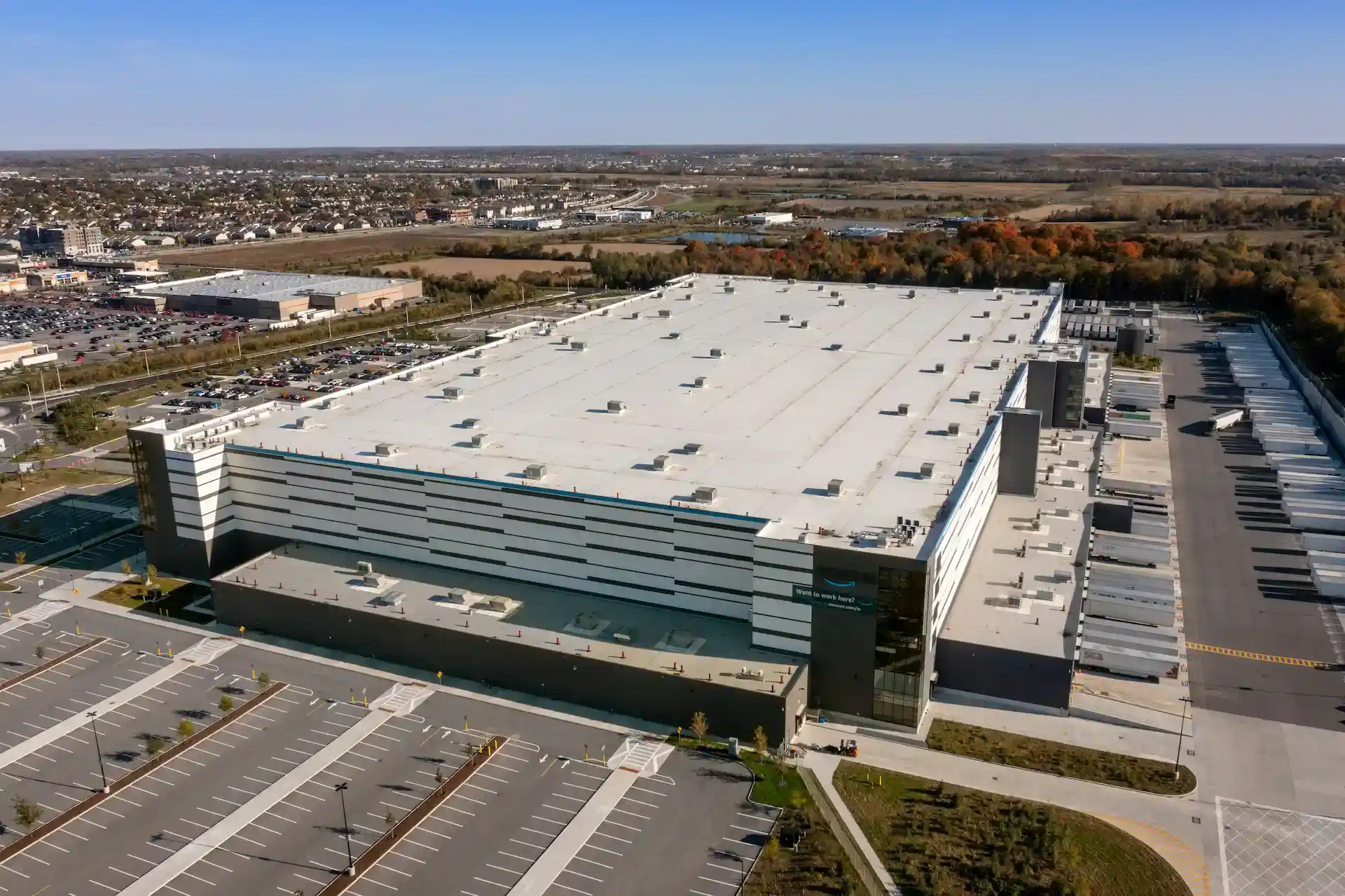
Warehouse and Distribution Center Roofing in Amarillo, TX
The Walmart distribution center on Amarillo's east side — a massive facility that serves retail stores across the Texas Panhandle and surrounding region — represents the kind of large-footprint warehouse roofing challenge that defines the industrial roofing market in this part of Texas. The Panhandle's extreme climate, featuring scorching summers, powerful winds, hail events, and occasional heavy snow, makes Amarillo one of the most demanding environments in the country for low-slope commercial roofing.
Wind uplift is arguably the most critical structural roofing design parameter in Amarillo. The Texas Panhandle is one of the windiest regions in the continental United States, with average wind speeds and peak gusts that rank among the highest for any flat-terrain area in the country. For a large warehouse with a flat or low-slope roof, wind uplift loads at roof edges, corners, and field areas are substantially higher than in most other Texas markets. Commercial roofing systems on Amarillo distribution facilities must meet the uplift requirements of ASCE 7 for the local design wind speed and exposure category — typically Exposure C or D for open Panhandle terrain — and attachment rates at the roof perimeter are often double or triple the field attachment rate.
Hail is a year-round threat in the Amarillo area, but the spring and early summer storm season from April through June brings the most severe events. Hailstones of 1.5 inches in diameter or larger are not unusual, and the insurance industry has classified much of the Texas Panhandle as a high-hail-frequency zone. Warehouse operators and their insurers have increasingly specified impact-resistant roofing assemblies — FM Global Class 4 or UL 2218 Class 4 equivalent — that qualify for insurance premium discounts. TPO membranes with adequate thickness (60 mil minimum) and proper substrate support resist moderate hail better than thin membranes over soft insulation.
Thermal stress from Amarillo's extreme temperature range adds another dimension of roofing complexity. Summer surface temperatures on a dark-colored roof can exceed 170°F, while winter lows can drop below 0°F. This 170-degree or greater potential range in surface temperature drives significant thermal movement in roof membranes, flashings, and metal components. TPO's heat-welded seams are particularly well-suited to this environment because the seam has essentially the same thermal expansion coefficient as the membrane itself, avoiding the mismatch stress that affects adhesive-bonded seam systems.
Dock door and truck court conditions at Amarillo's large distribution centers require flashing systems engineered for the Panhandle's wind-driven rain conditions. Wind speeds during thunderstorms and blue northers can drive rain horizontally into dock canopy-to-wall intersections that would be adequately protected in calmer climates. Counterflashing heights at these locations should exceed typical minimums, and sealant selection should account for UV intensity — Amarillo receives strong solar radiation even in winter months, making standard caulk products crack and shrink faster than they would in cloudier northern markets.
Ventilation requirements for large Amarillo warehouses are shaped by summer heat gain. A large distribution building with inadequate roof ventilation or insulation can see interior temperatures climb well above 100°F in July and August, creating dangerous working conditions and damaging temperature-sensitive inventory. Rooftop make-up air units, exhaust fans, and ridge ventilators must be properly curbed and flashed, and their operation creates pressure differentials that, if not properly accounted for in the building envelope design, can draw conditioned air through membrane penetrations or wall-to-roof transitions.
Energy efficiency for Amarillo warehouses is primarily a cooling-season issue, though heating costs in winter are not trivial given the Panhandle's cold winters. A white TPO membrane with high solar reflectance reduces daytime heat gain significantly — roof surface temperatures on a white membrane can be 50 to 70°F cooler than an equivalent dark surface on a July afternoon. Texas does not mandate Title 24-style prescriptive roofing standards, but IECC and ASHRAE 90.1 are commonly referenced in Amarillo permitting, and Climate Zone 3B requirements apply to the Panhandle area.
Cost per square foot for warehouse roofing in Amarillo is affected by the relatively limited pool of large commercial roofing contractors in the Panhandle compared to Dallas-Fort Worth or Houston. Material transport costs from major distribution points and the premium for impact-resistant or wind-uplift-rated systems push pricing to $8 to $13 per square foot for TPO re-roofing and $16 to $22 per square foot for full tear-off with new insulation. These costs are often at least partially offset by insurance incentives for FM-approved assemblies, making the upgrade calculation relatively straightforward for risk-conscious operators.
Regular inspection and documentation is especially important for Amarillo warehouse roofs given the frequency of hail and wind events. After any significant weather event, a professional roof inspection to identify and document fresh damage supports insurance claims and prevents small punctures or seam separations from becoming interior leaks. Warehouse operators in the Panhandle who maintain detailed inspection records and promptly repair documented storm damage consistently receive more favorable treatment from their insurance carriers at renewal.
- Why is wind uplift such a critical design factor for Amarillo warehouse roofs?
- The Texas Panhandle is one of the windiest flat-terrain regions in the country, and open-exposure warehouse buildings face uplift forces that can exceed the capacity of standard fastening patterns. Perimeter and corner attachment rates on Amarillo distribution center roofs are typically double or triple the field rate to meet ASCE 7 design requirements for the local wind speed and exposure category.
- Should Amarillo warehouse operators specify impact-resistant roofing?
- Yes — the Panhandle's high hail frequency and large hailstone potential make FM Class 4 or UL 2218 Class 4 impact-resistant assemblies a sound investment. Insurance premium discounts for qualifying assemblies often partially offset the additional upfront cost, and the protection against puncture damage preserves the roof warranty.
- What membrane is best for Amarillo's extreme temperature range?
- TPO with heat-welded seams is preferred because the seam material matches the membrane's thermal expansion coefficient, avoiding the stress that causes adhesive or tape seam systems to fail under Amarillo's 170°F or greater potential annual surface temperature range.
- What energy code governs commercial warehouse roofing in Amarillo?
- Texas references IECC and ASHRAE 90.1 for commercial construction; Amarillo falls in Climate Zone 3B. White TPO membranes with high solar reflectance are standard on new and re-roofed Panhandle warehouses both for code compliance and to reduce July and August cooling loads.
- How much does warehouse re-roofing cost in Amarillo?
- TPO re-roofing runs $8 to $13 per square foot installed in the Amarillo market; full tear-off with new insulation typically ranges from $16 to $22 per square foot. The relatively small Panhandle contractor pool and impact-resistance premiums push costs slightly above major Texas metros, but insurance incentives can offset part of the difference.
Start a conversation
Send the building location, roof type if known, leak photos, tenant restrictions, and the timing pressure. We will help turn the roof concern into a clear next step.
Contact Commercial Roofing of Amarillo